
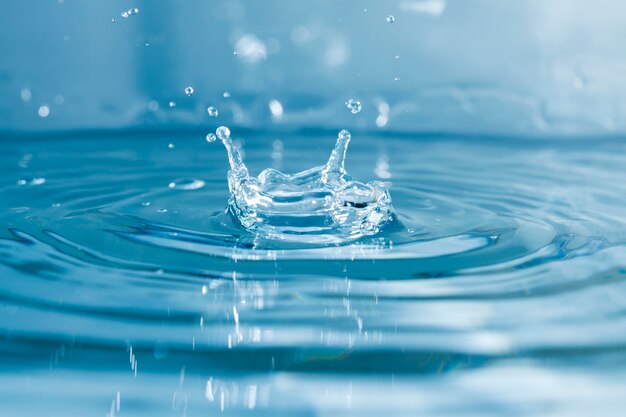
Water is the most essential and fascinating element on Earth, vital to all forms of life. This text explores its unique physical and chemical properties, its spiritual and cultural significance across civilizations, and groundbreaking research showing how water interacts with energy, emotions, and even human health. From its role in sustaining life to its mysterious memory and structure, this account reveals why water is truly extraordinary and indispensable.
Water, the most common element on earth. It is with us every moment of our lives. Although we consciously use it for drinking, washing, and so on, we nearly always overlook the relationship it has with our daily lives. Every living being on Earth begins its life in water. As fetuses, we are 99% water. Once born, we are 90% water. And when we reach adulthood, we are down to 70%, with 90% of our blood and plasma being water.
There are 100 times as many water molecules in our bodies as the sum of all the other molecules. And if you notice water, it’s everywhere actually. There’s no beginning, there’s no end. It’s one continuous being: the element of water. As we try to discover life on other planets, the first thing we look for is water. It is the second most common molecule in the universe after hydrogen. There is just as much water today as there was when the dinosaurs roamed, and less than 1% of the planet’s water is available to meet our daily needs.
Even with all the importance water holds in our daily lives, we know very little about it. Water has unusual physical and chemical properties compared to other liquids. Every day I get up thanking God for this environment. One of the reasons why I built a house by the water was so my son could also enjoy the benefits of living there. It’s peaceful, tranquil, it gives you very positive energy. It teaches you a lot about life. I used the river a lot for my flute programs and breathing exercises. I do a lot of underwater breathing.
Water’s properties are so unique that science has not yet been able to answer questions like: why is water the only substance that can exist in three different states—solid, liquid, and gas? Why is it the most powerful solvent on Earth? Why has water the highest surface tension of all liquids? Unlike other liquids, water’s density decreases below freezing point—it expands. Any other substance would do the opposite. If water did not exhibit any one of these properties, life itself wouldn’t exist.
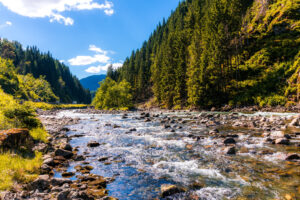
We usually tend to visit places that have naturally flowing water like rivers, waterfalls, and beaches. They are popular holiday and tourist spots. Waterfalls symbolize the flow of water and its healing power. Being around water can have a calming effect on us. It is a perfect stress buster. To meditate by the water is one of the best things you can do. It always changes your raging mind to a calm mind. It’s a very soothing effect on the mind. I think you need to be living by the water. All humans should live by the water. It will have a very positive effect on you.
It has been believed that the sun and the moon have an influence on the quality of water. This knowledge has been made use of in various alternative medicines like Ayurveda. The moon affects tidal waves, and our bodies react to changes in the atmosphere. Many reports have recorded unusual changes in the behavioral patterns of mentally ill patients on full moon days. Human beings are 70 to 90% water. Even at the molecular level, water plays a key role in creating the structure of DNA. The DNA helix cannot exist without water. If the moon can have such an impact on the planet so as to bring about climatic change, we being water bodies ourselves would also be affected.
In the Vedas, water is referred to as the most eternal. In Japan, water prefigures the purity and pliant simplicity of life. In China, water is considered the specific abode of the dragon because all life comes from the waters. The holy books of the Hindus explain that all the inhabitants of the Earth emerged from the primordial sea. In Christianity, baptism links the concepts of the water of life with the waters of purification. In the Quran are the words: “We have created every living thing from water.” Why is water considered sacred throughout history across the world? How is it so special?
Southeast Asia. The year is 1956. The place is a secret military laboratory for developing and producing weapons of mass destruction. Work had been underway here for several years on a powerful new generation of bacteriological weapons. The scientists were discussing what properties this weapon should have at one of their secret meetings. Suddenly, the session broke off. All of the participants were taken to the hospital with symptoms of severe food poisoning. An investigation quickly hit a dead end. The scientists had consumed nothing except water from the glass on their table. The water was tested. No harmful additives were found. Its chemical composition was H2O. And that’s what the report said: poisoning caused by ordinary water.
Around 1988, a groundbreaking hypothesis was put forward which explained water’s unpredictable behavior: water has memory. Water is capable of recording and storing information due to which it acquires new properties. Experiments around the world show water being capable of receiving and making an imprint of its outside influence. As it records new information, water acquires new properties, yet its chemical composition remains unchanged.
The sensational news is that the structure of water is more important than its chemical composition. The structure of water means how its molecules are organized. Water molecules join together as groups called clusters. Scientists suggested that these clusters work as memory cells, in which water holds the history of its relationship with the world. A cluster can survive for a short time, but as a structure, with molecules leaving and others joining, it can last a very long time. The stability of cluster structures confirmed the hypothesis that water is capable of recording and storing information.
Dr. Masaru Emoto from the IHM Institute studied water for many years. Through his research, he published Messages from Water, a collection of photographs showing the impact of external influences on water. His experiments proved that thoughts and vibrations can affect the structure of water. Water samples subjected to emotions, music, prayers, words, and other conditions were frozen and examined under a microscope. The crystals formed were then photographed. The results were remarkable.
Some water showed no crystal formation at all—like tap water. For example, a sample of tap water from Tokyo revealed no crystals. Animals instinctively choose spring water because it is loaded with natural energy. Dr. Emoto tested the effect of words spoken or written on water. Love increased energy levels and stabilized the water, while aggressive emotions reduced the energy and made radical changes. The most revolutionary discovery was water exposed to music, which showed beautiful crystals. This suggests that everything is energy, echoing Einstein’s statement, and supports Jacques Beniste’s hypothesis that water has memory.
In all of the world’s religions—Christianity, Islam, Judaism—it is customary to recite a prayer before eating or consecrating food. Why did such different traditions all adopt this? Science has discovered that prayers vibrate at 8 hertz, corresponding to the oscillations of the Earth’s magnetic field. A prayer pronounced with love affects the harmonic structure of water, an essential ingredient of all food. Dr. Emoto tested the influence of religious prayers on water, which could explain the concept of holy water.
We cannot hear the sound of the sun, but it makes a vibration as it moves through space. NASA compressed these waves into audible sound. The frequency of the sun is 126.22 hertz. With tone generators and speakers, water can be restructured to the sound of the sun. Researchers were astonished by the perfection of water crystals exposed to this frequency.
Water takes a long and difficult journey before arriving at our homes. Settlements once formed around natural water sources, but now water is transported through pipes with multiple right angles. This breaks down the molecular structure of water. In nature, water flows in spirals and curves, following the Fibonacci sequence, a numbering system present everywhere in nature—from flowers to DNA to galaxies. Water flowing naturally carries vortex energy, allowing it to purify itself. Pipe water loses this ability, explaining why bathing in waterfalls feels more refreshing than in tap water. The vortex motion oxygenates water, destroying pathogenic bacteria and restructuring it.
Devices have been created to restructure tap water. Tests showed that structured water can even affect human blood. In one experiment, blood cells that were clumped together regained their charge and buoyancy after the subject drank structured water, improving oxygenation and health indicators. Farmers also observed that strawberries watered with structured water had 20% higher nutrient density compared to others. Structured water requires less quantity, promotes healthier growth, and refreshes people who drink or bathe in it.
Despite the abundance of water on Earth, less than 1% is drinkable. Pollution and commodification of water have deprived more than half the world’s population of safe drinking water. Over 5 million people die each year from related causes. If left unsolved, water will become a cause for international conflict.
Still, some people take pride in keeping their environments clean and rivers free of garbage. This responsibility is vital. If thoughts and emotions can influence water, imagine what our thoughts can do to us.
Karishma Hansen & Nivedya Pankaj

4 Responses
Exactly what I was looking for, appreciate it for putting up.
So glad it reached you at the right time. Thank you for taking a moment to share that.
I was examining some of your content on this site and I believe this website is really informative ! Keep posting.
Thank you so much for taking the time to read and comment! I’m really glad you’re finding the content informative.