

The Amazon doesn’t whisper.
It breathes. It hums and pulses like a living mind spread across endless green — every leaf aware, every vine watching. Jeremy Narby, a young anthropologist from Switzerland, entered that world thinking he was there to observe. What he didn’t realize was that the forest was observing him too.
The Invitation
Narby arrived among the Asháninca people with his scientific tools, his training, and a quiet arrogance disguised as reason. His goal was to study how indigenous people cultivated their gardens so intelligently — without fertilizers or machinery. Their methods looked chaotic yet produced abundance. He wanted to know how.
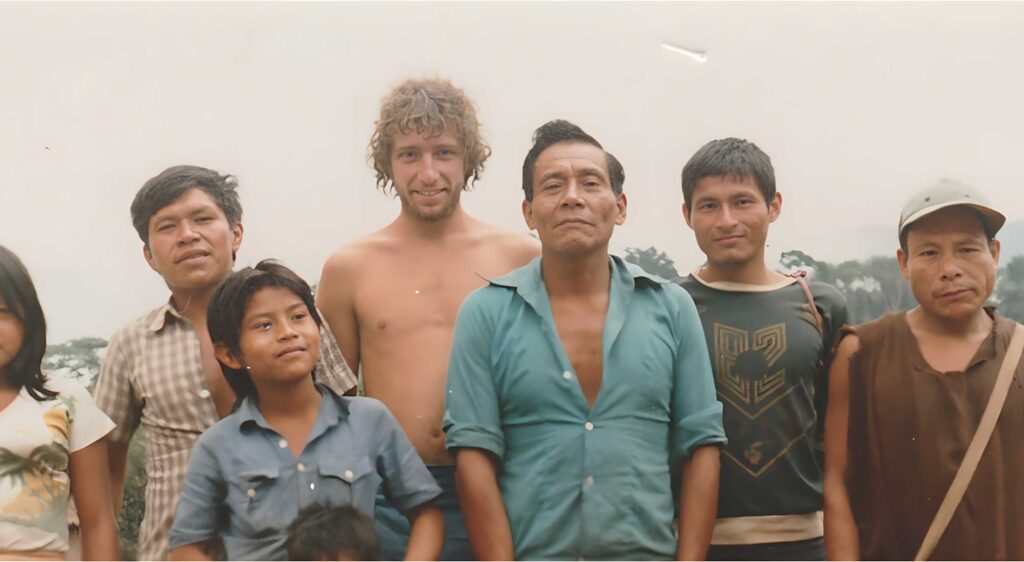
When he asked how they knew which plants healed, nourished, or repelled disease, he expected a logical explanation — trial and error, perhaps centuries of observation.
Instead, they said:
“We learned it from the plants.”
At first, Narby thought they were joking.
They weren’t.
Again and again, the answer was the same: the plants taught us.
And when he asked how such communication could happen, the reply was simple:
“Through ayahuasca.”
A shaman named Ruperto told him,
“Ayahuasca is the television of the forest. You drink it, and you see and learn things.”
Narby, the rational anthropologist, laughed politely. Still, curiosity pulled harder than skepticism. Ruperto offered to show him — and Narby, against his better judgment, said yes.
The Brew
That night, beneath a sky of wet obsidian, Narby sat cross-legged with Ruperto and a few others. The air smelled of smoke, river mud, and crushed leaves. He had ignored most of the shaman’s dietary rules — no salt, no meat, no fat — thinking they were superstitions.
Ruperto began by lighting a cigarette made of toe (Brugmansia), its smoke curling through the clearing. Then came the ayahuasca — a thick, bitter brew of vines and leaves containing DMT and natural MAO inhibitors. To science, that mix is pharmacological brilliance — two plants combined in a way that makes DMT orally active, something only precise biochemical knowledge could achieve.
To the Asháninca, it’s the voice of the forest.
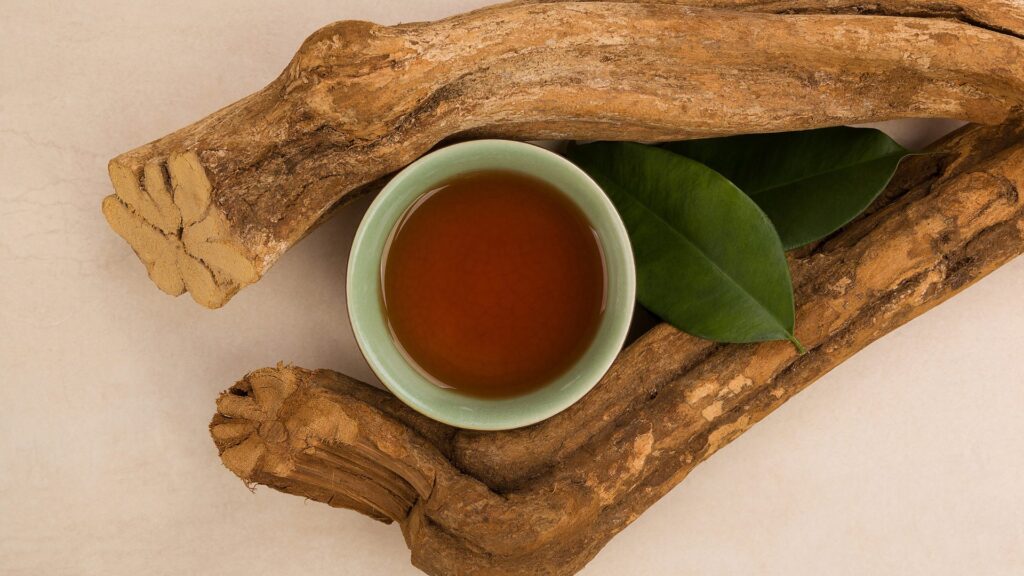
Ayahuasca drink, surrounded by Banisteriopsis caapi from the ayahuasca vine
Narby drank.
The world shifted.
At first came nausea, then violent purging. He staggered out to the edge of the firelight, gasping, clutching the earth. When he returned, pale and trembling, Ruperto looked at him calmly.
“You lost too much. You must drink again.”
He did.
The Descent
Reality cracked open.
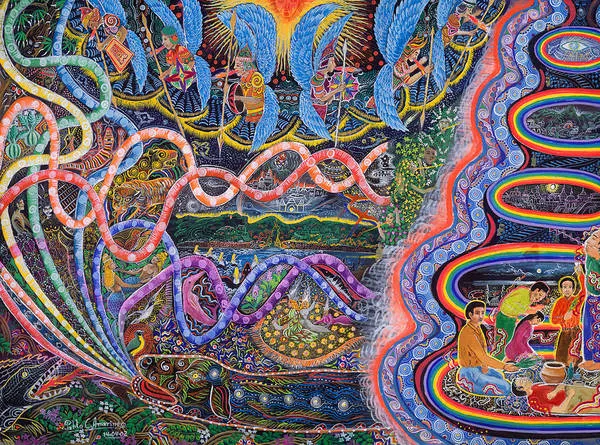
Colors pulsed behind his eyes. He saw enormous serpents twisting in green and gold light — luminous, alive, undeniable. He felt presences: one dark, one radiant, whispering in a language beyond words.
He saw inside himself — veins, bones, a glowing labyrinth. A woman in white appeared, floating a few meters away. His mind rebelled, but his body obeyed invisible instructions: spit now, breathe now, don’t drink water.
Ruperto’s gentle whistling became a thread holding his consciousness together. He felt himself rise, looking down at the Earth glowing with light.
A leaf’s veins became rivers, rivers became bloodstreams, bloodstreams became constellations.
Terror, creation, silence.
Then — stillness.
When he woke, the night had passed. The forest was still. Nothing looked the same anymore.
The Humbling
In the morning light, Narby stared at his notes. Everything the Asháninca had told him now made sense — in their world, their metaphors, their language. His world of definitions and categories suddenly looked thin.
He had been trained to separate myth from data. But these people worked through images and visions — and their medicines worked, their gardens thrived, their communities endured.
He couldn’t ignore that, even if he couldn’t explain it.
Narby speaking on what the forest showed him and how it changed everything.
Plants as Teachers
For the Asháninca, every plant is a teacher. They speak in colors, dreams, and intuitions earned through discipline and respect. Shamans — ayahuasqueros — don’t just use plants; they form relationships with them. The plant becomes a mentor, even a friend.
Anthropologist Luis Eduardo Luna calls this tradition vegetalismo — learning from plants through communication, not consumption.
Narby began to see that this wasn’t mysticism pretending to be science. It was a parallel science — one rooted in relationship instead of reduction.
The Skeptics and the Silent Intelligence
In academia, “plant communication” drew polite smiles and quick dismissals.
Plants don’t think.
Plants don’t feel.
Plants certainly don’t talk.
But science has a short memory. In the 1970s, Peter Tompkins and Christopher Bird’s The Secret Life of Plants documented experiments showing plants reacting to human emotion and thought through polygraphs (Check out the ZenFusion series ‘The Silent Intelligence Of Plants‘). Critics called it pseudoscience — yet modern research is slowly validating what those early experiments suggested.
Studies in plant neurobiology show plants send electrical signals, release chemical distress calls, and communicate through fungal networks. Recent research from Tel Aviv University even found that stressed tomato plants emit ultrasonic sounds — literal “cries” for help.
(Reuters, 2025)
Plants whisper at frequencies you can’t hear. See for yourself.
So maybe the Asháninca weren’t mistaken.
The Lesson Beneath the Leaves
Narby’s first ayahuasca journey didn’t hand him answers — it handed him questions.
Could intelligence exist in forms we dismiss?
Could communication happen through colors, sensations, and chemical whispers?
Could science learn to listen instead of measure?
He came seeking knowledge. What he found was humility.
And that is where true wisdom always begins.
“Wisdom requires not only the investigation of many things, but contemplation of the mystery.”
The Cosmic Serpent: DNA and the Origins of Knowledge
The Quiet Teachings
- Listen differently. The world is speaking, though rarely in words.
- Be humble in knowing. Certainty blinds more than ignorance ever will.
- Bridge, don’t divide. Science and spirit are two lenses of the same mystery.
- Let wonder in. The more we know, the less we understand.
- Remember the invitation. The forest doesn’t shout. It waits for those willing to listen.
Further Knowing
For those curious to explore more about the Amazon, ayahuasca, and the intelligence of plants, here are a few videos and books (linked to Amazon), to deepen your understanding:
Videos
Embark on a visual journey into the heart of the Amazon, where the ancient practice of ayahuasca ceremonies unveils the deep connection between humans and the plant world.
Jeremy Narby presents a scientific exploration of ayahuasca, bridging indigenous wisdom and modern biology to uncover the intelligence inherent in nature.
Books
- COSMIC SERPENT: DNA and the Origins of Knowledge by Jeremy Narby
Anthropologist Jeremy Narby explores the parallels between indigenous shamanic knowledge and modern molecular biology. Drawing from his experiences in the Amazon, he suggests that shamans access information about DNA through visionary states induced by ayahuasca. - The Secret Life of Plants by Peter Tompkins & Christopher Bird
This classic work investigates the emotional and communicative capacities of plants, presenting evidence of their responses to stimuli such as music and human emotions. The book blends scientific research with anecdotal accounts, challenging conventional views on plant intelligence. - Ayahuasca Reader: Encounters with the Amazon’s Sacred Vine by by Luis Eduardo Luna PhD, Professor Steven F. White PhD, Ralph Metzner PhD, Gerardo Reichel-Dolmatoff, Alex Grey, Dale Pendell
This anthology compiles a diverse range of texts—myths, hymns, essays, and scientific analyses—offering insights into the ayahuasca experience from multiple perspectives. It serves as a comprehensive resource for understanding the cultural and spiritual significance of ayahuasca in Amazonian traditions. - Jaguar That Roams the Mind: An Amazonian Plant Spirit Odyssey by Robert Tindall
Robert Tindall shares his personal journey into the heart of Amazonian shamanism. He delves into the transformative experiences with ayahuasca and the deep connection between shamans and plant spirits, providing a firsthand account of the spiritual practices in the Amazon. - The Mind of Plants: Narratives of Vegetal Intelligence by John C. Ryan, Monica Gagliano, Patricia Vieira
A collection of essays, narratives, and poetry exploring the complex relationships between humans and plants, highlighting the intelligence and consciousness of the vegetal world. - THIS IS YOUR MIND ON PLANTS by by Michael Pollan
Pollan examines the cultural and personal impact of three psychoactive plants—opium, caffeine, and mescaline—offering insights into how these substances shape human experience and consciousness. - Plant Spirit Healing by by Pam Montgomery
This guide explores the healing powers of plant spirits, offering a hands-on approach to working with plant consciousness for personal and spiritual growth. - Visionary Plant Consciousness: The Shamanic Teachings of the Plant World by by J.P. Harpignies
A compilation of writings from leading experts discussing how psychoactive plants facilitate communication with nature’s “voice” and what this means for our future. - Journeys With Plant Spirits by Emma Farrell
A guide to communicating and working with plant and tree spirits for personal development, spiritual connection, inner peace, and healing.
Next — The Language of the Serpent
Narby’s journey had only begun. The forest had shown him visions he couldn’t yet understand — serpents of light, whispering in patterns that felt ancient and alive.
In the next chapter, he follows their trail.
What do these serpents mean?
And why do they appear in myths, medicine, and even the very code of life itself?

2 Responses
I am not real fantastic with English but I get hold this really easy to translate.
I’m really glad the content made sense to you. 😊
Thank you for taking the time to read and write back. It truly means a lot to me.