
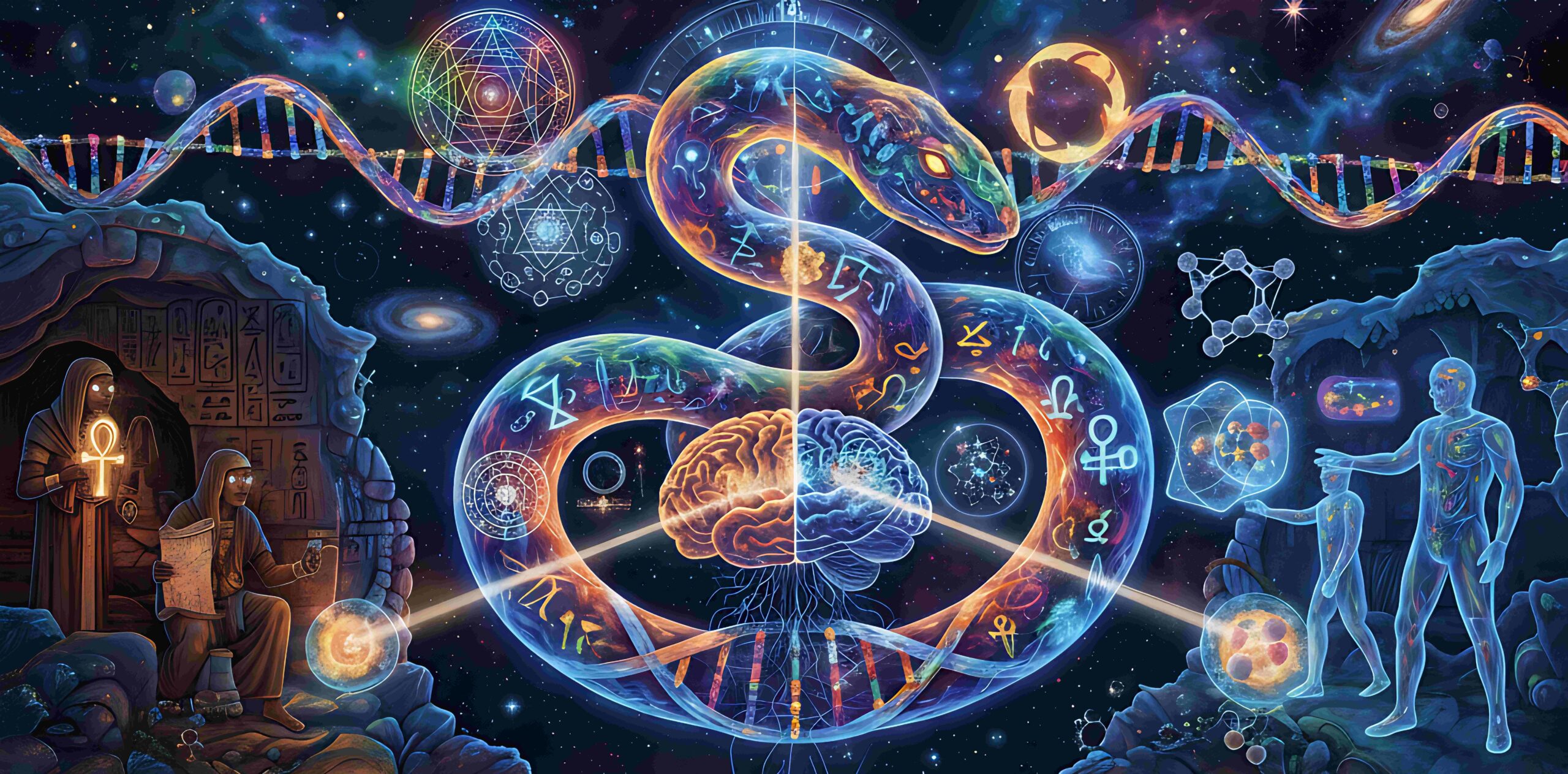
When Reality Begins to Crack
We live believing our senses are reliable guides—our eyes show us what is there, our minds sort truth from illusion, and the world exists “out there,” solid and measurable. This certainty is comforting. It gives us the feeling that we understand how life works, that reality is stable under our feet.
But there are moments—fleeting, disorienting moments—when that certainty trembles.
This is the territory Jeremy Narby stepped into—not through imagination, but through testimonies so consistent, so detailed, and so ancient that they began to challenge the very foundations of the Western mind. Accounts from Amazonian shamans spoke of serpents that were not symbolic, but alive with intelligence; of cosmic architectures that felt not imagined, but remembered; of visions that revealed information their recipients had no ordinary way of knowing.
Narby did not begin as a believer. He began as a scientist—skeptical, rational, and grounded in evidence. But evidence, it turned out, was not confined to microscopes and laboratories. It appeared in visions described with surgical precision by people who had never met, across cultures separated by thousands of miles, all pointing toward the same hidden reality.
The deeper he went, the more his own intellectual framework began to splinter. Was consciousness merely a byproduct of the brain? Or could the brain be a receiver—tuned, under certain conditions, to perceive something far older and far more universal than any individual mind?
The question was no longer academic.
It was personal.
It was existential.
The Collapse Of His Previous Framework
Science had given him tools, but it had also blinded him through reductionism. He saw that the same scientific establishment which claimed certainty often admitted ignorance about its foundational questions: What is consciousness? How do hallucinogens work? Why do unrelated cultures share identical visions?
Suddenly, the conflict was no longer between science and shamanism—it was within his own perception. And I felt it too. Reading about these experiences made me question how much of my reality had been filtered, constrained, and pre-determined by habit and expectation.
A New Way of Knowing Emerges
At this point, the journey could not move forward through accumulation of information alone. It required a shift in mode of awareness. Narby was being driven forward by a force greater than his conscious will—but he could only navigate this terrain by surrendering to intuition, silence, and inner vision.
He stopped trying to force understanding. Instead, he allowed the mystery to remain undefined while continuing to observe patterns. In that subtle shift—this moment of defocalization—the first bridge appeared.
Seeing Through the Illusion
Narby had spent months chasing a puzzle he could barely name. He had read endlessly, cataloged visions, and dissected ethnographies—but the pieces never quite fit. The shamans’ visions were consistent across continents, precise and structured, yet entirely alien to his Western-trained mind. And then there were his own experiences under ayahuasca, which mirrored them in unsettling detail. They were not mere hallucinations or symbolic archetypes; they were real in the way the world outside my window was real—coherent, alive, and insistent.
Yet a question gnawed at him: how could people, separated by thousands of miles, see the same intricate forms? The answer seemed to hover just beyond perception, teasing him, but always retreating when he tried to grasp it intellectually. I felt a flicker of recognition myself: could my own mind be trained to see patterns I had never noticed?
Then one evening, in a casual, almost mundane setting, the barrier began to break. A friend handed him a book of stereograms—pages of chaotic dots and strange, abstract patterns.
“Stop trying to see,” the hostess instructed gently. “Let your eyes go. Look through the page, not at it.”
Narby tried, and failed. His mind, trained for focus, resisted the surrender. But persistence softened the resistance. He relaxed, his eyes unfocused, his breath slowing, his tension dissolving.
And then it happened.
The image emerged. A dolphin, leaping effortlessly through unseen waves, springing from the chaos of dots into a vivid, three-dimensional presence. It was as if the form had always existed, waiting for his perception to align with it. When he refocused, the dolphin vanished, leaving only the meaningless dots behind.
Narby’s heart raced. This was no mere visual trick. It was a metaphor made flesh: perception was not simply about seeing—it was about how one sees. Shamans were not hallucinating; they were perceiving another layer of reality, accessible only when the mind and senses were unshackled from ordinary focus. And I realized the same could be true for me.
From that night onward, Narby approached his work differently. He taped a simple command to his wall:
LOOK AT THE FORM.
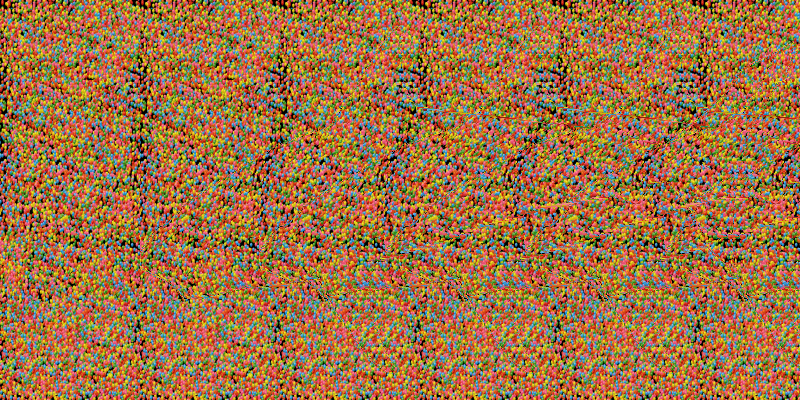
Try it yourself:
Relax your eyes. Don’t look at the image, look through it as if your gaze is passing into the distance. Let the dots blur slightly. Don’t force it. Allow perception to change on its own—and notice how form emerges from the formless. Have patience, it may take a while.
This is the very shift Narby experienced: the realization that reality is not only what we look at, but what we are able to perceive when we step out of ordinary focus.
What reveals itself is not imagination—it is information waiting for the right state of consciousness.
This autostereogram encodes a hidden three-dimensional image of a shark swimming through space. At first glance, it appears to be just random dots—but when the viewer uses a “wall-eyed” technique (relaxing the gaze as if looking past the image rather than at it), two repeating dot patterns merge, and the shark rises into view from the flat surface. This is not a visual trick—it is an exercise in shifting perception. What appears chaotic transforms into coherence the moment the eyes stop trying to focus in their usual way, mirroring the shift in consciousness that allowed Narby to perceive hidden layers of reality.
If that was difficult, follow this tutorial.
The note became a mantra. Ordinary reading transformed into active perception. Scientific papers and ethnographic records no longer presented facts to memorize—they were landscapes to traverse, patterns to unlock. And in that traversal, he stumbled upon a disquieting truth: science did not truly know how vision works.
Hallucinogens and the Brain – Beyond LSD to the Mystery of DMT
Narby’s investigation deepened, and with it, a new realization took hold: Western science had been looking in the wrong place. Researchers obsessed over LSD, a synthetic compound, while largely ignoring the plant medicines that shamans had been using for millennia. LSD, he discovered, was a curiosity—vivid, yes, but limited. It produced pseudo-hallucinations: users knew they were seeing distortions, not another world.

The plants were different. Ayahuasca, the vine of the soul, carried within it DMT, a molecule naturally present in the human body. It was a messenger that came from within, bridging biology and consciousness. Under its influence, vision transcended the ordinary: ordinary objects faded, and immersive, coherent worlds emerged. People entered realms, encountered beings, received information that felt as real and instructive as any waking observation.
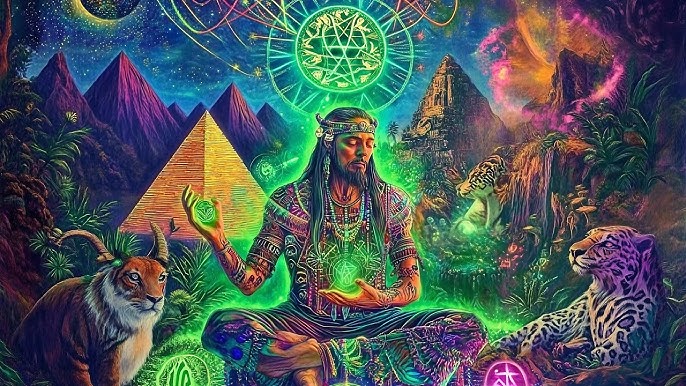
Modern neuroscience now confirms what shamans have known intuitively for centuries. DMT binds to serotonin receptors, igniting perception and quieting the ego—the Default Mode Network—leaving the mind untethered from the confines of identity. With the usual filters lifted, consciousness flows freely, connecting memory, emotion, and sensation into a unified whole. The visions are not projections of fantasy—they are, in a sense, revelations of patterns normally invisible.
For Narby, this was electrifying. The similarity between visions across cultures could no longer be dismissed. The Conibo, the Desana, the Yagua—they all described serpents, twins, spirals of light, and architectures of life remarkably alike. It was as if the human mind, given the right conditions, tuned into a universal language encoded deep within biology itself. And I felt a thrill—what else could our minds perceive if we learned to soften, to unsee, to tune in?
In the defocalized state, perception no longer fragments into isolated facts. Instead, it illuminates the connections between things—mind and matter, spirit and body, biology and myth. Narby saw a new possibility: visionary experiences were not meaningless hallucinations, but a cognitive interface, a way for consciousness to perceive information embedded in the living world itself.
Visionary Experiences Across Cultures: Serpents, Consciousness, and the Origins of Life
Narby’s investigation revealed a striking pattern: across continents and centuries, indigenous peoples reported astonishingly similar experiences—visions of serpents, spirals, twin-like forms, and cosmic architectures. These were not chaotic hallucinations, but structured, coherent presences, full of meaning.
The Conibo: Telepathic Revelations of Life
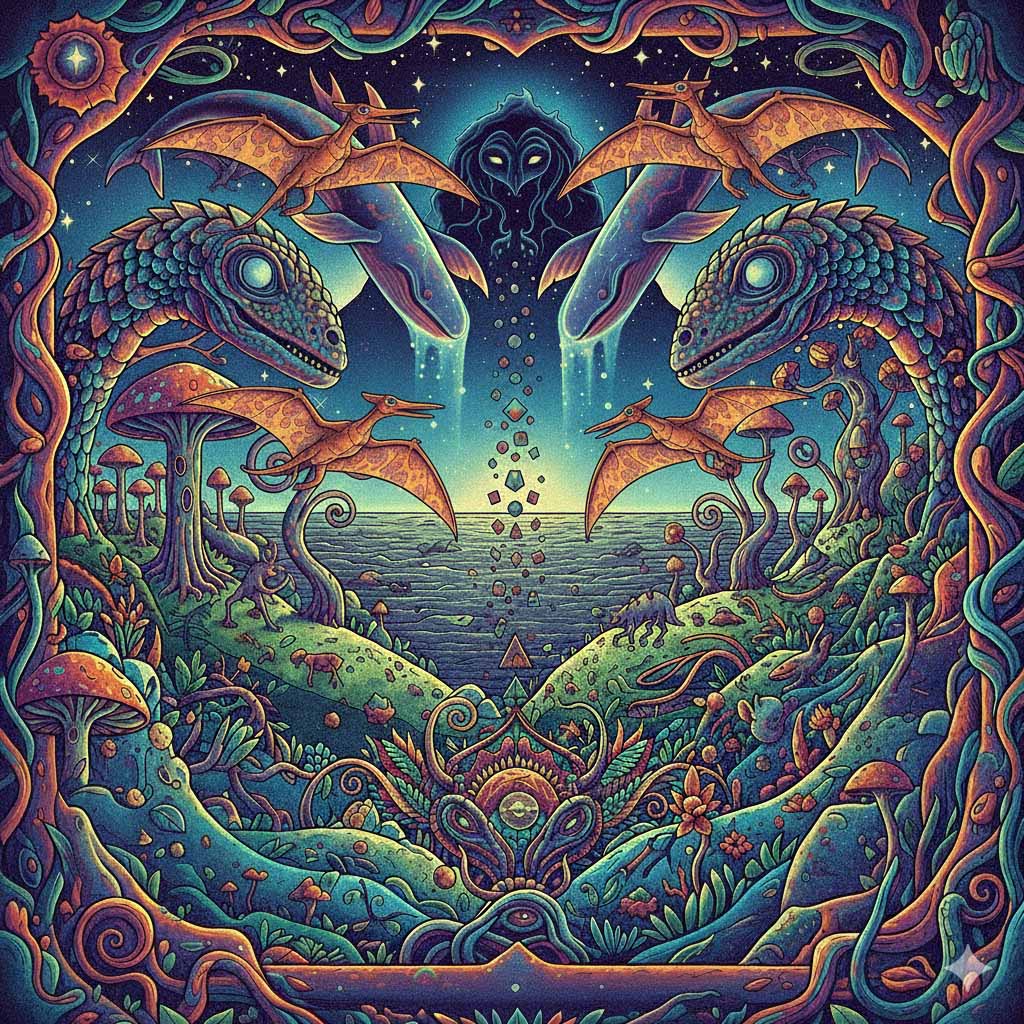
In 1968, anthropologist Michael Harner participated in ayahuasca ceremonies with the Conibo of Peru. He encountered a “supernatural carnival of beings,” fantastic and terrifying, yet precise and organized. Reptilian entities emerged within his consciousness, projecting telepathic images of Earth’s creation. He witnessed barren oceans, then massive whale-like creatures descending from the skies, fleeing an enemy from deep space. To survive, they created life on Earth as camouflage.
Time accelerated: evolution unfolded before him—plants rising from water, animals crawling onto land, life blooming in a panoramic spectacle of intelligence and purpose. These beings conveyed a final, shocking truth: they were not gone; they still existed within all living things, including humans.
The Desana: The Cosmic Anaconda in the Brain
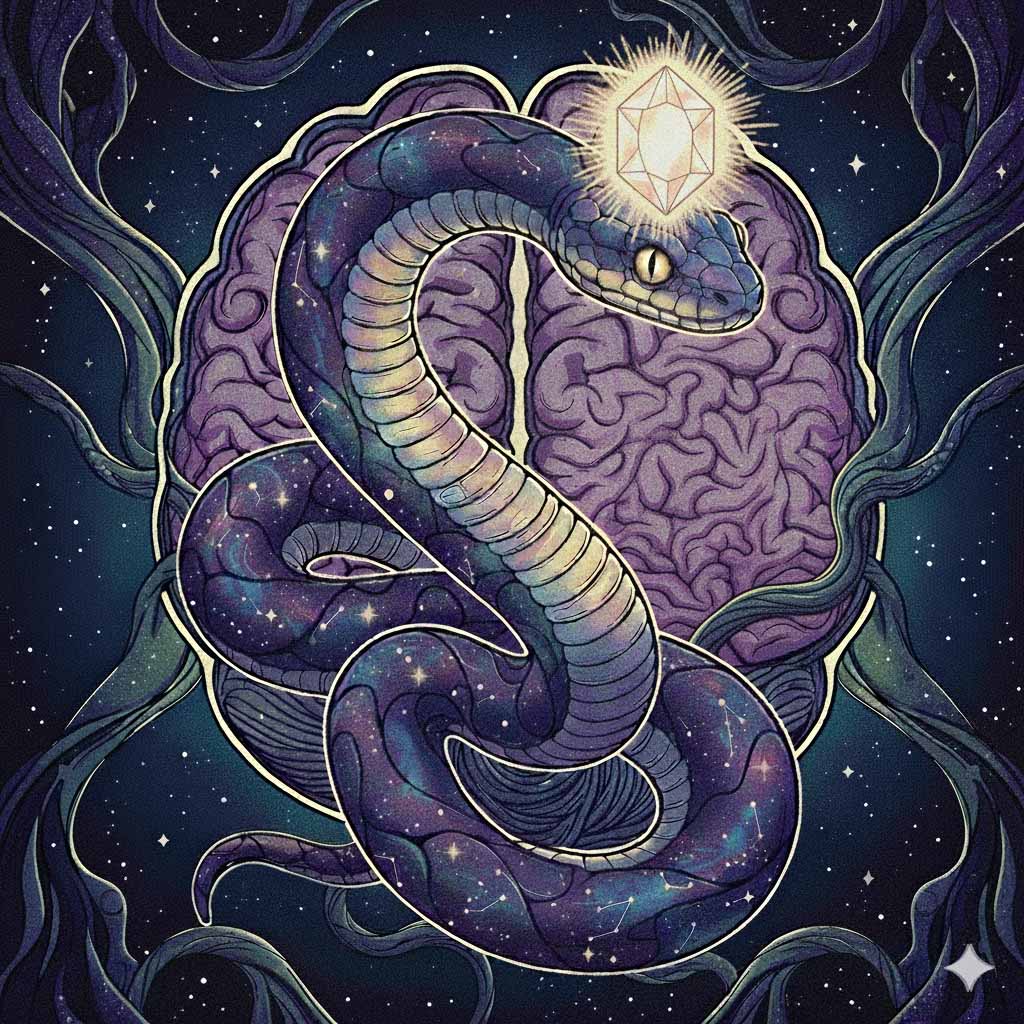
The Desana people of Colombia described a single cosmic anaconda coiled along the central fissure of the brain—a sacred being responsible for initiating consciousness.
According to the Desana elders, this fissure was not merely anatomical. It was a sacred space, formed “in the beginning of time”, both mythically and embryologically, by the cosmic anaconda—a primal being responsible for initiating life and awareness. Near the serpent’s head was drawn a hexagonal crystal outside the brain.
The Desana explained that this crystal contained a particle of solar energy, radiating consciousness into the brain.
Narby paused. This wasn’t simply mythology—it was a detailed cosmology describing the origin of awareness.
The Yagua: Twin Serpents and Celestial Creation
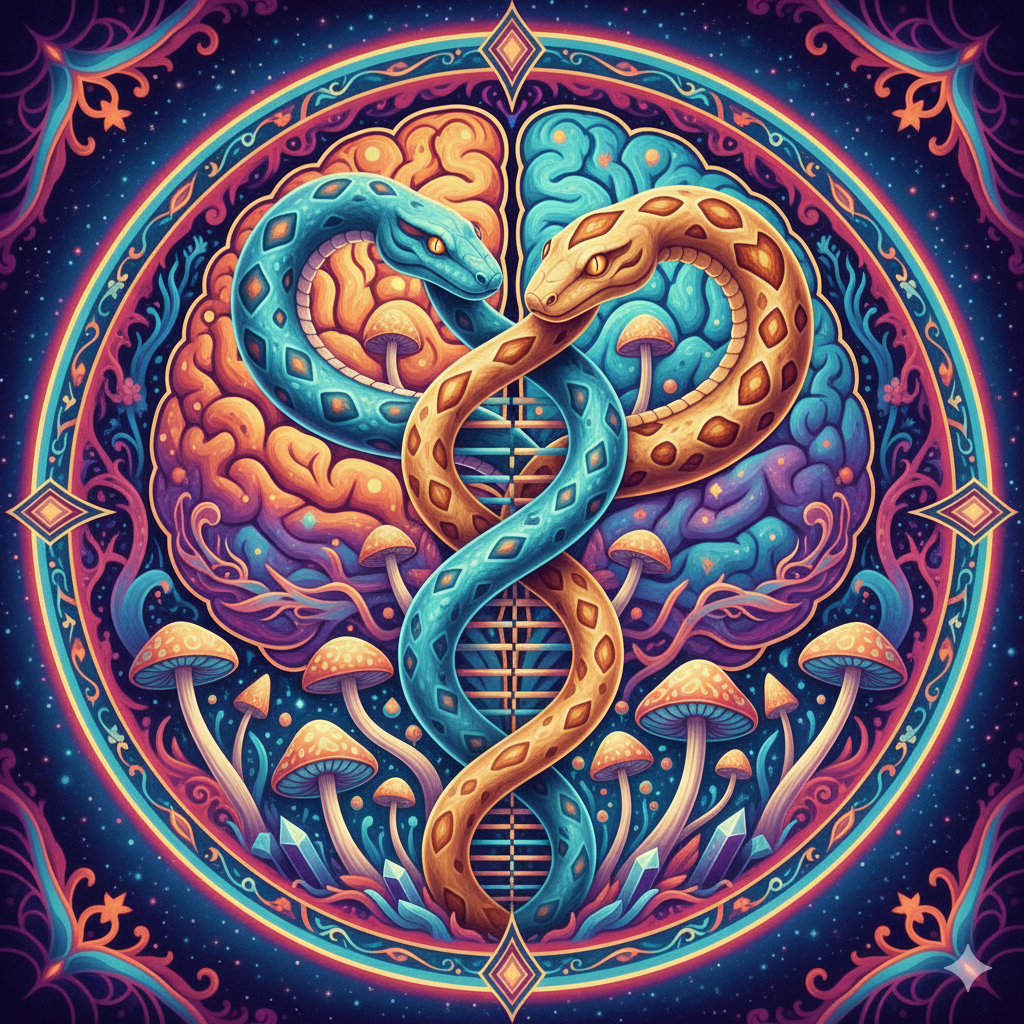
By contrast, the Yagua depicted two large serpents intertwined forming the fissure of the brain.
Reichel-Dolmatoff (the anthropologist who documented this visionexplained their symbolism:
- The anaconda represented water, the feminine, the dark, the internal.
- The boa represented land, the masculine, the bright, the external.
Together, they embodied the binary nature of reality—male and female, inner and outer, earth and sky. The Desana shamans described these serpents as alive, moving in rhythmic spirals from side to side. Their motion maintained balance and conscious awareness.
This was not a symbol of conflict—it was a living representation of harmony and integration. Consciousness, according to the Desana, emerged from the union of these two spiraling forces.By contrast, the Yagua depicted two large serpents intertwined, representing duality: male and female, sky and earth, light and dark. Across cultures, Narby saw the same motif: serpents, duality, and the origins of life.
Connecting the Visions to DNA
Narby encountered a footnote in Harner’s writings:
“In retrospect, one could say they were almost like DNA, although at that time, 1961, I knew nothing of DNA.”
Narby paused. DNA exists both inside humans and inside plants. It is literally the shared code of life, present in every cell of every organism. Could it be that Ayahuasca—known as “the vine of the soul”—did not just cause hallucinations, but actually enabled consciousness to interface with this fundamental biological intelligence?
This was pivotal. The imagery of single and twin serpents, predating knowledge of the double helix, suggested the visions were perceiving a fundamental structure embedded in life itself. Shamans were not hallucinating—they were accessing intelligence encoded in the spiral forms of life.
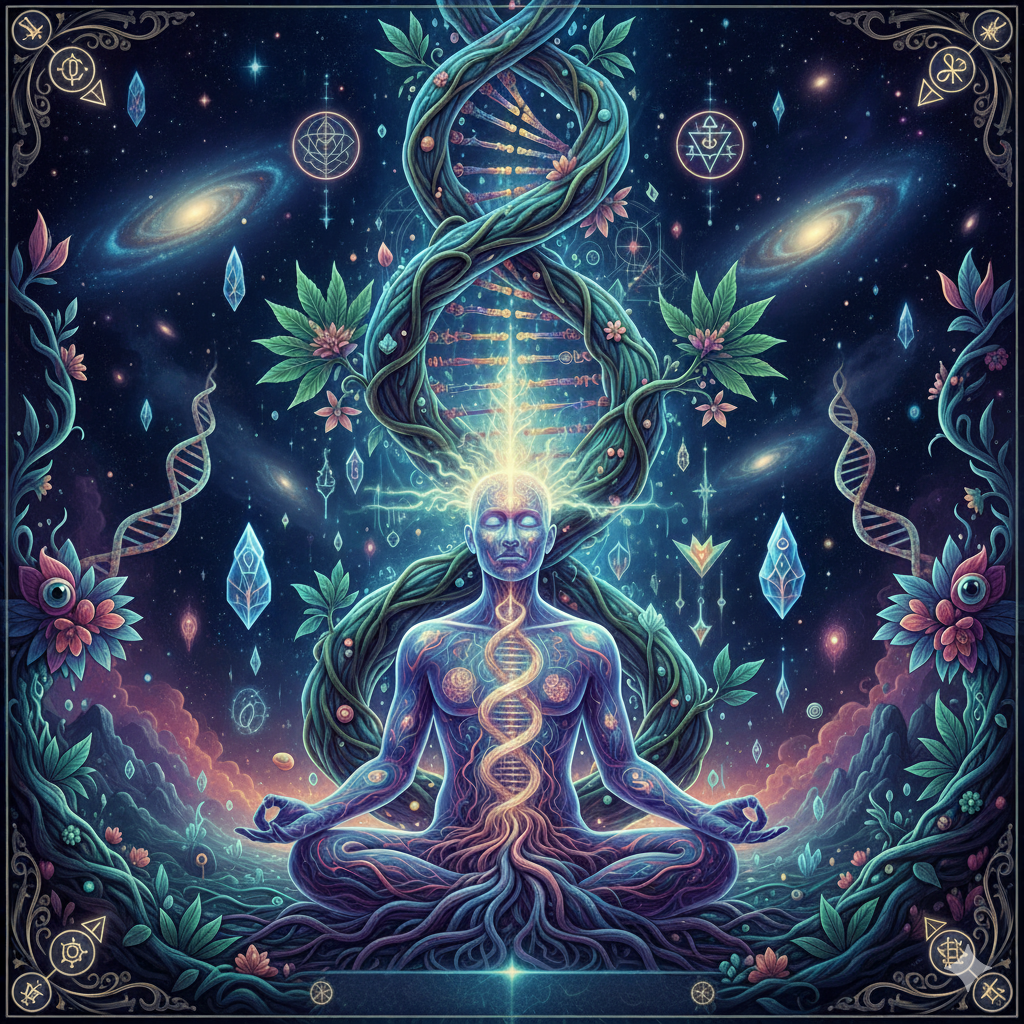
Serpents, Twins, and the Double Helix
Across Amazonian cultures, serpents consistently appear in cosmology and visions:
- The Desana people depict a snake lodged between the two hemispheres of the brain.
- The Conibo describe reptilian beings projecting the origins of life.
- The Yagua speak of celestial serpents and say life was created by twins—a striking parallel to the two entwined strands of DNA.
Narby begins to see the same message encoded in myth and biology:
- Serpent = Life force
- Twins = Double Helix
- Cosmic Origin = DNA as the universal blueprint of life
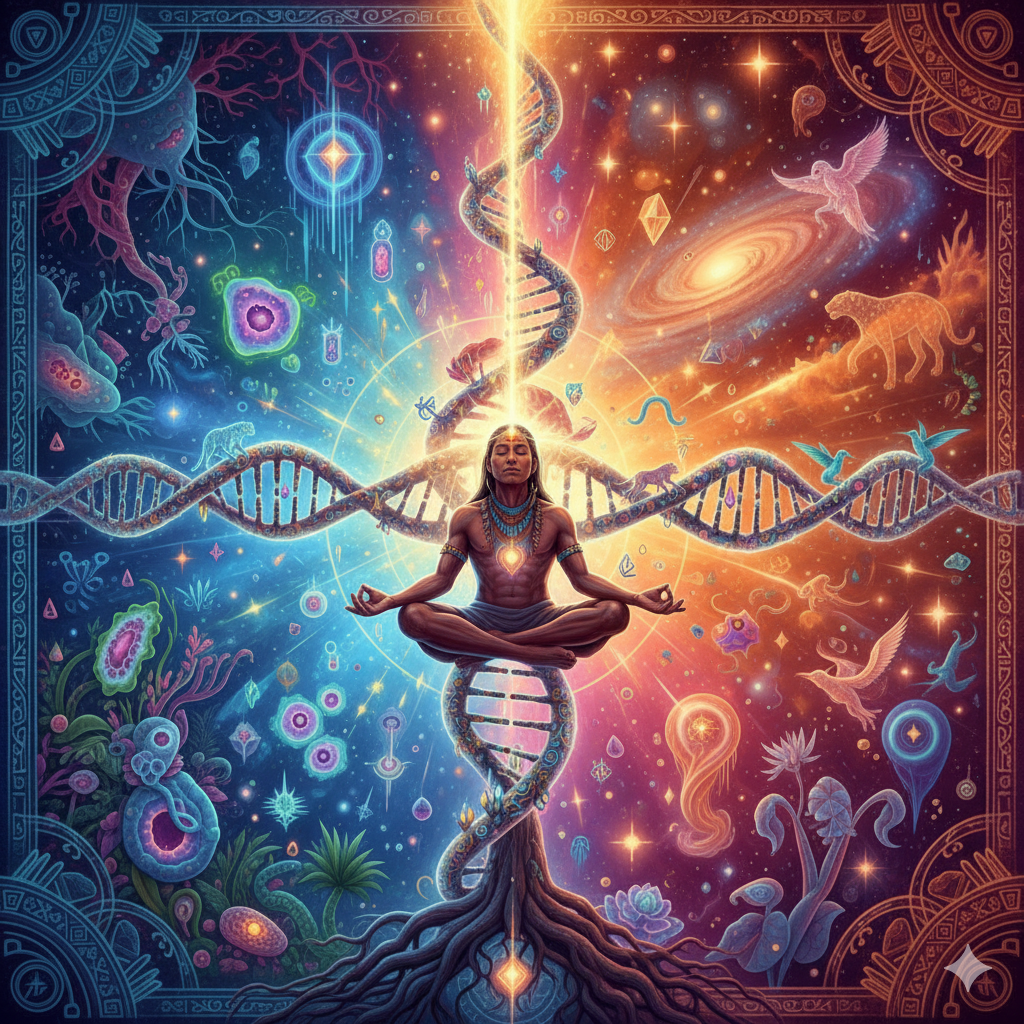
Shamans, through altered states of consciousness, may be accessing information stored in the DNA itself—not metaphorically, but directly. DNA becomes the bridge between inner and outer worlds—between biology and spirit.
DNA as a Living Intelligence
Modern science shows that psychedelics like DMT (contained in ayahuasca) increase neuroplasticity, altering how the brain processes information. Under this influence, the mind may perceive underlying structures normally hidden from everyday consciousness.
This aligns precisely with shamanic claims:
- Shamans say plants teach them.
- Plants contain DNA.
- Humans contain DNA.
- DNA may be the common language of life—accessible in states where perception is expanded.
Narby’s insight is revolutionary:
- Hallucinatory serpent imagery seen during ayahuasca rituals may not be psychological fantasy.
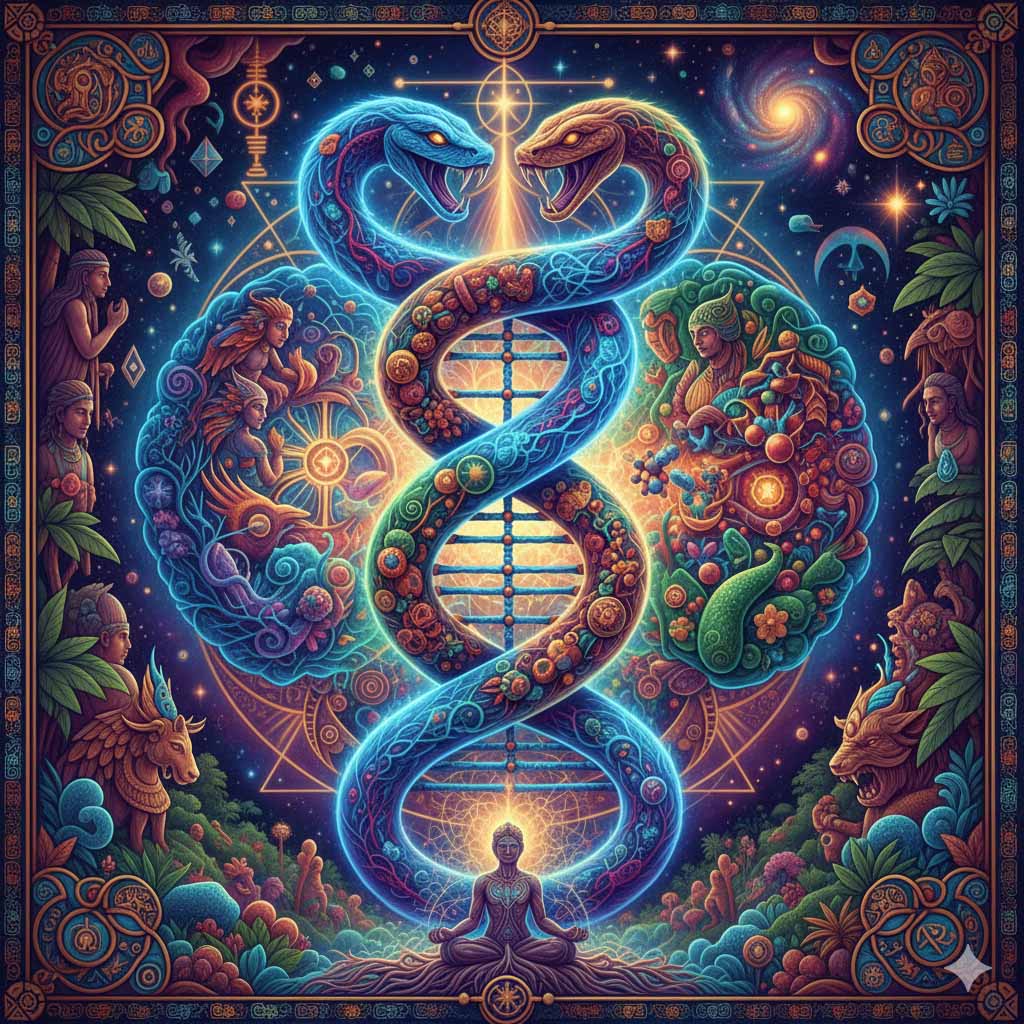
- It could be an ancient, intuitive recognition of the double-helix structure of DNA—the universal code shared by plants, animals, and humans.
- DNA is not a mere biological molecule; it may be the cosmic communicator, the source of the knowledge shamans receive.
This is the moment where mythology, neuroscience, and molecular biology converge—revealing that the serpents of vision and the serpents of science may be one and the same.
Reconciling Science and Indigenous Knowledge
Narby’s methodology—holding one eye on science and one eye on shamanism—is not just poetic. It reflects a cognitive strategy that neuroscience increasingly recognizes: integrative perception. By combining empirical understanding of neural mechanisms with experiential, symbolic insights from shamanic practice, one can identify patterns that neither domain alone fully captures.
- From science: We understand serotonin receptor mechanisms, neuroplasticity, and the limits of perception.
- From shamanism: We access symbolic representations, cosmologies, and knowledge encoded in ritual and hallucination.
Together, these perspectives suggest that consciousness is both a receiver and a constructor of information—capable of perceiving what is embedded in nature, yet filtered through neurobiological constraints.
ZenFusion’s Reflection
Serpents, Balance, and the Harmony of Life
The more I explore this research—from Amazonian shamans to ancient yogis, from tribal visions to modern science—the more I sense a timeless truth revealing itself:
Humanity has always known one constant, expressed in countless ways:
Life is balance.

Not just outer balance—of ecosystems, seasons, and elements—but inner balance: energies, thoughts, emotions, and spirit.
In India, Shiva appears as Ardhanarishvara—half man, half woman—reminding us that creation itself emerges from the union of opposites. The serpent around his neck, waits silently to rise in all of us, only when inner harmony is attained.
In China, Yin and Yang show that light carries darkness, and darkness holds light. Both co-exist.
From the Aboriginal Rainbow Serpent to the Egyptian Ouroboros, from the Hopi snake dances to the African god Dan, the message is the same: life flourishes when opposites dance together—not when one dominates the other.
Why does every culture know this?
Jeremy Narby saw serpents in shamanic visions. Yogis describe rising serpent energy. Modern science sees entwined serpents at the core of our biology—the double helix of DNA. Could it be that every ancient tradition, every mystical experience, points to this universal truth: balance is not merely philosophical—it is a living law, encoded into every cell?
When Jesus said, “Judge not, that ye be not judged,” and “Love your enemy,” perhaps he was not only teaching kindness, but something deeper: a surrender to balance. Love—even for those who hurt or oppose us—is recognition that life itself moves through complementary forces. Letting go of judgment allows perception to open, revealing more than the limited reality our minds are conditioned to see.
Too much happiness can make us reckless.
Too much discipline can make us rigid.
Too much freedom becomes chaos.
Too much order becomes tyranny.
Nature mirrors this: day needs night, growth needs decay, creation needs destruction, inhale needs exhale.
The serpent, coiled at the root of our being, embodies this living equilibrium. It waits, not to strike, but to remind us to embrace both light and shadow without judgment. True peace emerges not from vanquishing one force or the other, but from honoring their sacred interplay.
Further Viewing & Reading
For those inspired to explore further, we’ve curated a selection of videos and books that deepen the themes discussed in this article. The videos offer immersive visual and narrative experiences, while the books provide thoughtful perspectives and detailed research. Each book title below is linked directly to Amazon, allowing you to easily learn more and purchase a copy if you wish.
Videos
Sadhguru narrates a fascinating incident, wherein he discovered a nagmani – a mysterious jewel believed to grow on a cobra. This video could shed light on the vision of snakes by the Desana people of Columbia.
An investigation into the long-obscured mystery of dimethyltryptamine (DMT)
Sadhguru talks about the lesser-known mystical dimensions of Nagas or the sacred serpents, and their significance in spiritual pursuit and mystical exploration.
Books
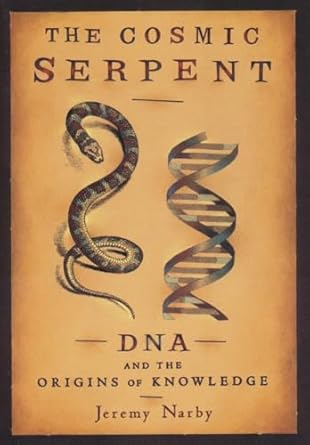
The Cosmic Serpent: DNA and the Origins of Knowledge by Jeremy Narby
Jeremy Narby explores the intriguing connection between DNA and ancient shamanic visions, suggesting that indigenous knowledge systems may have insights into molecular biology.
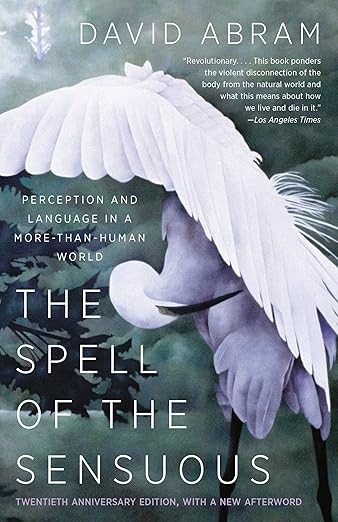
The Spell of the Sensuous by David Abram
This book examines how our sensory experiences shape our perception of the world, drawing from philosophy, shamanism, and ecology.
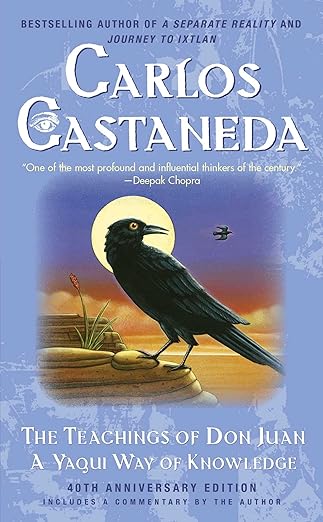
The Teachings of Don Juan: A Yaqui Way Of Knowledge by by Carlos Castaneda
Carlos Castaneda’s classic work documents his apprenticeship with a Yaqui Indian sorcerer, delving into the use of hallucinogenic plants and the expansion of consciousness.
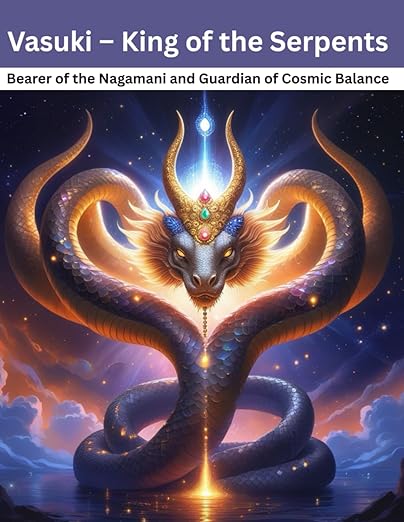
Vasuki – King of the Serpents: Bearer of the Nagamani and Guardian of Cosmic Balance by by Mohan Chandra Uprety
Vasuki – King of the Serpents explores Vasuki as a cosmic guardian and symbol of transformation, embodying balance, endurance, and sacred wisdom. It reveals the mystical Nagamani as a metaphor for awakening inner awareness.
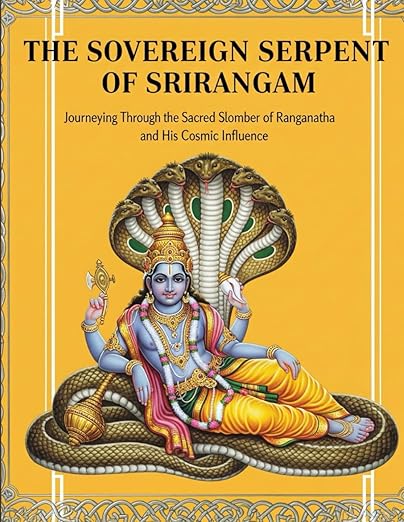
The Sovereign Serpent of Srirangam: Journeying Through the Sacred Slumber of Ranganatha and His Cosmic Influence by by Mohan Chandra Uprety
The Sovereign Serpent of Srirangam reveals the cosmic role of Lord Ranganatha’s slumber and Adishesha, the celestial serpent, symbolizing divine support, Kundalini energy, and inner potential.
The Gene Keys by RICHARD RUDD
This book explores the idea that our DNA holds the blueprint of our destiny, offering “gene keys” as a tool to transform beliefs and raise consciousness. It includes online hologenetic profiles to reveal the genetic patterns shaping life, relationships, and health.
TRUE HALLUCINATIONS by by Terence McKenna
Recounts Terence McKenna’s wild Amazon adventures with his brother and friends, exploring hallucinogens, consciousness, and the origins of language through surreal, fantastical encounters.
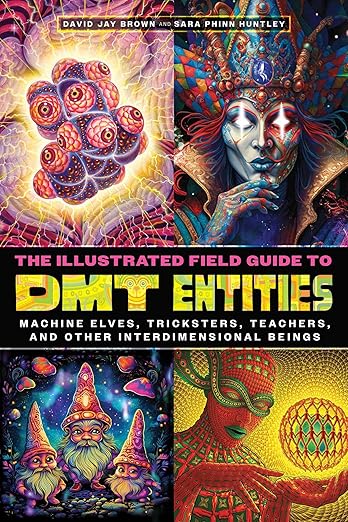
The Illustrated Field Guide to DMT Entities: Machine Elves, Tricksters, Teachers, and Other Interdimensional Beings by by David Jay Brown, Sara Phinn Huntley
DMT and the Alien World of Ayahuasca explores 25 common DMT and ayahuasca entities, their appearances, behaviors, and teachings, illustrated with visionary art.

Making Dmt Simplified: A simplified step by step guide on learning how to produce DMT the spirit molecule in a quick and reliable way from your home by by Eric Jonas
Making DMT Simplified is a clear, beginner-friendly guide to understanding DMT extraction, covering basic methods, safety, and essential tips without giving explicit instructions.
Dmt Entity Encounters by by David Luke, Rory Spowers, Anton Bilton
This book captures insights from leading psychedelic researchers and thinkers on DMT, exploring visions of nonhuman entities, plant sentience, alien encounters, and consciousness expansion, based on discussions at the 2017 Tyringham Hall symposium.
Dmt Dialogues by by David Luke, Rory Spowers, Anton Bilton
This book presents groundbreaking discussions from top researchers on DMT, plant intelligence, and interspecies communication, exploring whether consciousness exists beyond the human mind and how DMT may act as a bridge between spirit and matter.
Food of the Gods by by Terence McKenna
A groundbreaking exploration of psychedelics and consciousness by Terence McKenna, this book challenges mainstream perceptions and offers a visionary take on how mind-altering substances can reshape human understanding and evolution.
Sacred Knowledge: Psychedelics and Religious Experiences by by William Richards
Sacred Knowledge explores how responsibly used psychedelics can unlock healing, expand consciousness, and offer profound spiritual insight, based on decades of scientific research and clinical experience.
Beyond Ayahuasca: Unlocking the Evolutionary Science of Indigenous Amazonian Wisdom to Access Your Highest Potential by by Roman Hanis
Beyond Ayahuasca offers a practical and spiritual guide to Amazonian shamanic wisdom, sharing traditional tools, self-inquiry practices, and ceremonial insights to help readers heal, transform, and awaken to their fullest human potential.
References
Narby, Jeremy. The Cosmic Serpent: DNA and the Origins of Knowledge. New York: Tarcher/Putnam, 1998.
McKenna, Terence. Food of the Gods: The Search for the Original Tree of Knowledge. Bantam Books, 1992.
McKenna, Terence. True Hallucinations. HarperOne, 1993.
Harner, Michael. The Way of the Shaman. Harper & Row, 1980.
Dobkin de Rios, Marlene. Visionary Vine: Hallucinogenic Healing in the Peruvian Amazon. Waveland Press, 1984.
Luna, Luis Eduardo, and Pablo Amaringo. Ayahuasca Visions: The Religious Iconography of a Peruvian Shaman. North Atlantic Books, 1999.
Winkelman, Michael. “Shamanism and the Altered States of Consciousness Mechanism.” Journal of Psychoactive Drugs, 1989.
Baker, J.D. Plant Spirit Shamanism: Traditional Techniques for Healing the Soul. Destiny Books, 2006.
Grof, Stanislav. The Cosmic Game: Explorations of the Frontiers of Human Consciousness. SUNY Press, 1998.
Narby, Jeremy & Huxley, Francis (eds). Shamans Through Time: 500 Years on the Path to Knowledge. Tarcher/Penguin, 2001.

No responses yet